03.11.2026.
Revision rhinoplasty
Revision surgery didn't bring the result you wanted, and scars or thickening make breathing difficult or change the shape of your nose? Revision rhinoplasty is significantly more complex than primary surgery, takes longer, and costs more, often requiring cartilage from the ear or rib for reconstruction.
At Royal Plastic Surgery in Belgrade, we correct the consequences of previous operations, regardless of where they were performed. The goal is a natural nose shape and free breathing, and you will find out the exact price immediately after your consultation. Schedule an examination.


- Blog
- Revision rhinoplasty
The nose is at the center of your face, and every imperfection is visible every day: in the mirror, in photographs, with every smile. If you have already had nose surgery and the result is not what you imagined, or your breathing is not the same as before, know that you are not alone and that a solution exists. The decision to correct what was not done well is not a weakness, but a step toward a nose you will finally be satisfied with.
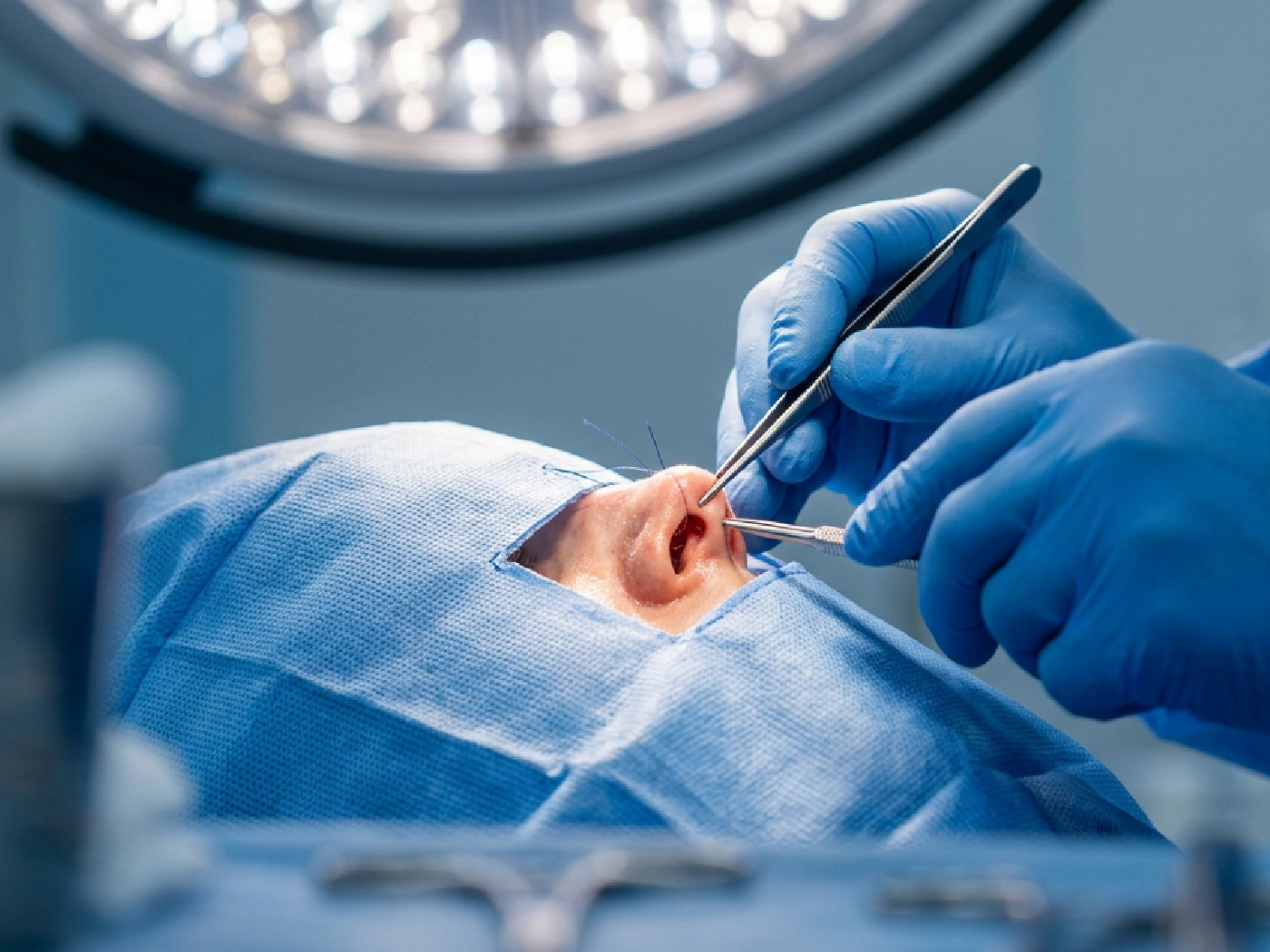
Revision rhinoplasty is intended precisely for such cases: asymmetry, a drooping nasal tip, irregularities on the bridge, hard scar thickening, and breathing difficulties after the first operation. At Royal Plastic Surgery, every nose begins with a detailed consultation, followed by a realistic plan, a clear quote with no surprises, and follow-up care throughout your recovery.
A repeat surgery is more complex than the first, which is why choosing the surgeon is the most important decision along the entire journey. Below, we explain step-by-step what revision rhinoplasty is, when it is performed, why it is harder, why it takes longer and costs more, what recovery looks like, and what to pay attention to before making your decision.
What Is Revision Rhinoplasty?
Revision rhinoplasty is a secondary nose surgery. It is performed when the initial surgery did not yield the desired result or when breathing became more difficult afterward. It can also be done if the first operation was performed by a different surgeon or clinic.
A primary surgery and a revision are not the same. In a primary operation, the surgeon works on a nose that has never been operated on. In a revision, they work on a nose that has already been altered: there is scar tissue underneath the skin, and a portion of the cartilage supporting the nose shape is often missing. Therefore, a revision is more demanding and requires greater experience.
More about the surgeries that most frequently precede revision can be read on our pages: rhinoplasty (nose shaping), septoplasty (correction of the nasal septum), and septorhinoplasty (a combination of both procedures). In short, this is a more difficult and longer surgery than the first one, so it should be approached seriously and patiently.
When Is a Repeat Nose Surgery Performed?
Regarding appearance, the most common issues include a nonsymmetrical nose, irregularities or depressions on the bridge, a nasal tip that is too drooping or has lost its shape, as well as a hump that remained or reappeared. Some patients have a nose that looks unnatural because it has been over-operated. Regarding breathing, reasons may include narrowed nasal passages, nasal wings that collapse during inhalation, or a nasal septum that was not properly straightened. Sometimes, hard scar thickening beneath the skin that is visible externally, usually on the tip of the nose, is also bothersome.
Whether a revision is truly necessary is decided only after an examination, as sometimes a minor correction is sufficient, while other times a larger reconstruction is required.
When Is the Right Time for a Revision?
In most cases, at least one year should pass since the previous surgery. During this time, swelling subsides, the tissue heals, and the nose settles into its permanent shape. If operated on too early, the surgeon works on a nose that is still changing and cannot reliably predict how it will ultimately look.
Exceptions exist, for example, when complications arise or breathing is seriously impaired, but in such cases, the surgeon decides everything after an examination.
Why Is a Revision Harder Than the First Surgery?
There are three reasons why a repeat nose operation is more demanding, which also explain why it takes longer and costs more.
Scar Tissue and Thickening
After every surgery, the body creates scar tissue. In the nose, this tissue is located beneath the skin, around the bone and cartilage. Such tissue is harder and denser than healthy tissue, stretches less, and is more difficult to separate from what lies beneath it. Therefore, the surgeon must work more slowly and carefully, layer by layer, to avoid damaging the skin. Scar tissue also takes longer to release swelling, so recovery takes more time.
Lack of Cartilage
During the first surgery, a portion of the cartilage or bone is often removed. If too much is removed, the nose loses support, causing the tip to drop, nostrils to narrow, and breathing to become more difficult. In a revision, this support must be rebuilt, which requires cartilage. The surgeon most commonly takes it from the patient themselves, from the nasal septum, ear, or rib. This is an additional step in the surgery, and in the case of the rib, involves a small incision on the chest wall.
Less Margin for Error
The skin on a nose that has already been operated on is often thinner, and blood circulation is weaker, leaving less room for corrections. This requires careful preoperative planning and expertise in such procedures. For this reason, a surgeon should not be chosen based on price alone.
All of this together means that a revision is performed more slowly, more carefully, and with significantly more experience.
Duration of Surgery and Technique
A primary nose surgery usually takes about two hours, while a revision takes on average 3 to 5 hours. It can take even longer if a major reconstruction or harvesting rib cartilage is required. The duration depends on the amount of scar tissue, how much cartilage is missing, and how many changes need to be made. The operation is performed under general anesthesia with an anesthesiologist team. An open technique is most commonly used, where a small incision is made on the columella between the nostrils, allowing the surgeon better visibility and greater precision. For minor corrections, a closed technique without external incisions is sometimes sufficient.
A longer surgery does not indicate a complication, but rather that the surgeon is working carefully and without rushing.
Cost of Revision Rhinoplasty
The price of revision rhinoplasty is higher than that of a standard, primary rhinoplasty, and this is a difference worth knowing in advance.
The first nose surgery is a more standardized procedure: the nose has not been operated on, the tissue is healthy, and the surgeon knows what to expect. In a revision, every case is different and more demanding. The operation takes longer, meaning the operating room and anesthesia are occupied for a greater duration. A larger team and an experienced surgeon in such cases are required. The procedure is more complex, often involving cartilage harvested from another part of the body, and requires more time for preparation and planning beforehand. Frequent follow-up checks are needed after surgery.
Because of this, the price of a revision is not a fixed sum, but depends on the complexity of the procedure: the amount of scar tissue, the missing cartilage, where it is harvested from, and how many corrections are needed. The exact price is determined after an examination, when the surgeon can assess what needs to be done.
A promotional offer is currently available, allowing patients to resolve both aesthetic and functional issues under more favorable conditions:
Revision rhinoplasty: from €4,500 (regular price €5,200)
What Recovery Looks Like?
Recovery after a revision takes longer than after the first surgery because scar tissue releases swelling more slowly.
During the first few days, swelling and bruising around the nose and eyes are normal. The nose is protected by a splint, which is typically worn for about a week. Bruising and the major part of the swelling disappear within two to three weeks, and most patients return to daily activities after about two weeks. Sports and strenuous activities are resumed gradually as advised by the surgeon. Swelling inside the nose, especially at the tip, subsides the slowest, so the final shape of the nose settles only after 12 to 18 months.
Therefore, it is important to know that the true result is not visible immediately and that patience is required.
Realistic Expectations from Nose Revision
A revision can significantly improve both appearance and breathing, but it is important to have realistic expectations.
The result depends on how much healthy tissue remains, how thick the skin is, how your body heals, and how many surgeries have already taken place. The goal is a nose that looks natural, fits your face, and functions well, rather than perfection that anatomy does not allow. As with any surgery, there are risks such as infection, bleeding, asymmetry, or the need for another correction, about which the surgeon informs you in detail before your decision.
An honest conversation before surgery is the best foundation for satisfaction afterward.
Choosing a Surgeon for a Nose Revision
For a repeat nose operation, choosing the surgeon is more important than for the first, because mistakes are harder to correct.
It is worth asking whether the surgeon has experience with revisions rather than just primary operations, and reviewing examples of similar cases. During the consultation, the surgeon should examine you thoroughly, including your breathing, and speak openly about what is possible and what is not. They should explain the surgical plan and how they will monitor your recovery. A surgeon who promises a perfect result without an examination is not acting in your best interest.
A good surgeon will tell you what is possible, not just what you want to hear.
Why Choose Royal Plastic Surgery Belgrade for Revision Rhinoplasty?
Royal Plastic Surgery has over 15 years of experience and has performed more than 7,000 aesthetic surgeries.
Our team consists of experienced surgeons who use modern techniques and take an individualized approach to every patient. During the consultation, the surgeon assesses the tissue condition, scars, and nasal patency, then creates a realistic surgical plan aimed at ensuring the nose is safe, functions well, and looks natural. We are with you from the first consultation through the operation and recovery, with special attention to safety and post-operative care.
How to Schedule an Appointment for Revision Rhinoplasty?
If you wish to schedule an appointment, find out the price of a nose revision, or ask questions, call us at +381 62 92 49 195 or visit the following pages: Nose Surgery, Nose tip surgery, and Complete Nose Surgery.


Royal Plastic Surgery
Why choose us?
The best, most affordable and safest aesthetic clinic in Belgrade and Serbia.